
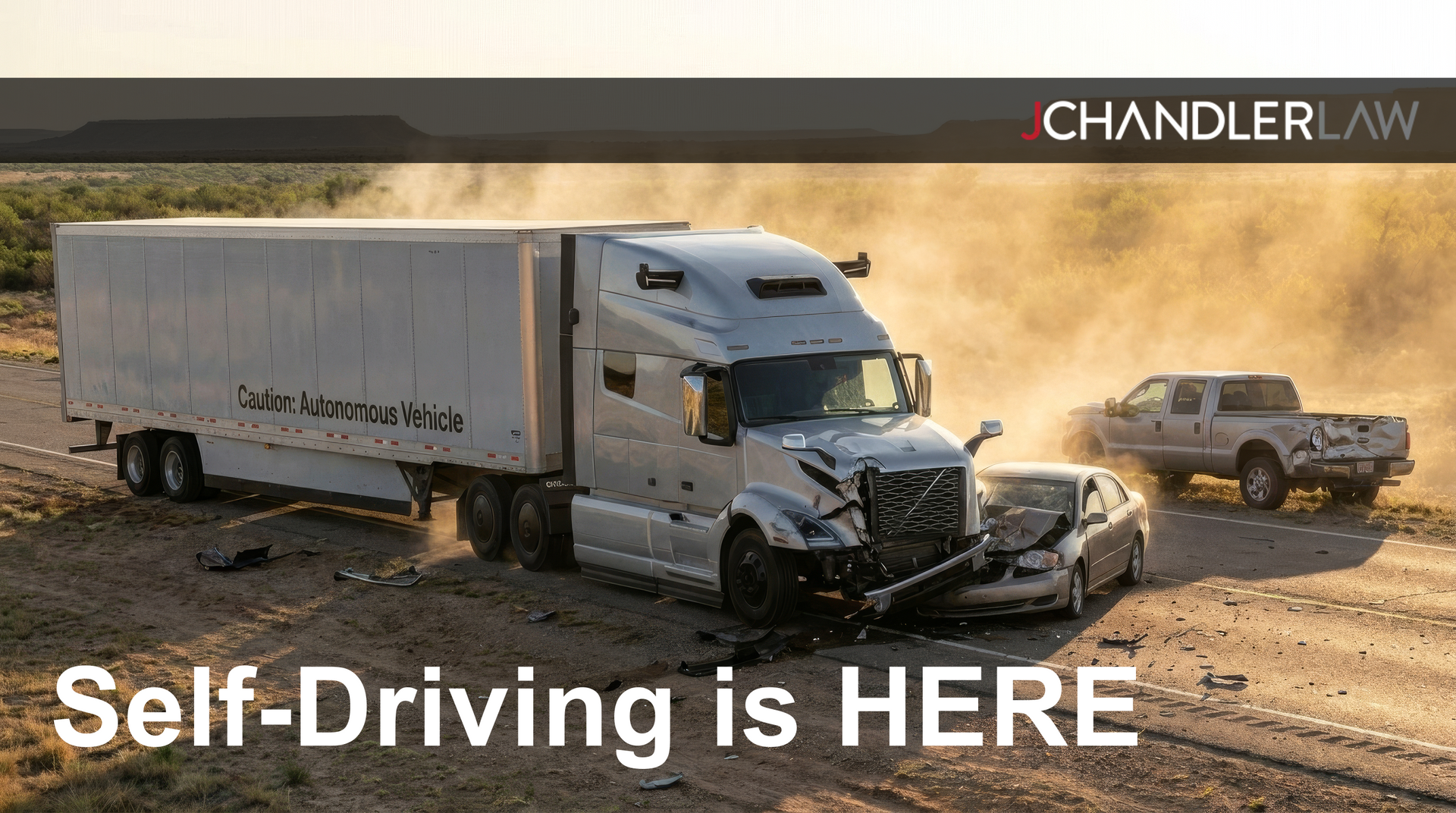
Self-Driving Wrecks Are Here. Who's Your Expert?
by J Chandler Law
September 17, 2026
For years, fully autonomous commercial trucks felt like a distant promise. That is no longer true. Driverless 18-wheelers are now hauling real freight on real highways, and the pace of expansion is accelerating fast. When wrecks do occur, liability can be more complicated, and the facts can be more technological. Many law firms will be behind the tech curve and unable to protect your rights as well as you might deserve.
Is This Tech A Good Thing?
Self-driving or automated vehicles, and vehicles with accident-avoidance technologies, are expected to help reduce injuries and deaths in a big way. Overall, that’s a good thing. If the right of Texans to choose the vehicle they drive is generally preserved, and if privacy is appropriately respected, then we’re all for new technologies that save lives and prevent injuries.
In fact, as counter intuitive as it may seem, many injury lawyers want to reduce the need for so many injury lawyers. By holding negligent parties to account, with your help, we can play a huge part in deterring harmful behavior in the future. Think of some of the procedures and practices that companies adopt to protect you. Much of what we now take for granted originally arose from justified lawsuits of the past.
How does this apply to artificial intelligence (AI) and self-driving cars and trucks?
Vehicle automation is in its infancy. There have been, and will continue to be, mistakes along the way. But together, we can help right individual wrongs while helping the industry remember to prioritize safety.
Will There Still Be Wrecks?
Unfortunately, yes. Your injury could sprout from a few categories of causation:
1. Rushed or Immature Tech
Companies have a lot of incentive to rush technology – if they can get away with it. Usually, they are responsible and make the right judgements. But you already know that isn’t always the case.
Technology that is rushed out too quickly could cause your accident.
2. At Fault Exceptions
Even where the industry manages the technology roll outs well, and hopefully saves lives on average, an automated vehicle could be completely at fault in your particular accident. Think of everything from computer system errors to faulty physical components, map data, or sensors.
3. The Human Factor
There are still opportunities for negligent people to cause harm, even though their vehicle may have tools to help prevent harm. Beyond human design of the systems, consider improper physical maintenance, improper tech support and management, improper human instruction or supervision, or negligent behavior around the loading or unloading of trucks, just for a few examples.
Should I Give Them A Pass?
You might consider two reasons to be steadfast in holding negligent automated vehicle operators to account:
1. Personal Harm
If they harm you, regardless of how well they are performing on average, you need to be made whole again. That’s your right. And we suggest you contact a law firm prepared to handle this new technological world.
2. Collective Harm
We need the industry to be on their toes, so they do their absolute best to prevent harm.
They need to know that people will stand up, and that there are tech-savvy law firms that are prepared, capable, and willing to effectively take them on if they cut corners and harm people.
Why Liability Gets More Complicated
A traditional truck accident case typically centers on a driver's conduct and the company’s hiring, training, and supervision practices.
An autonomous truck accident can involve a far longer list of potentially responsible parties: the trucking company that deployed the vehicle, the company that developed the self-driving software, the truck manufacturer, the sensor and hardware suppliers, the remote monitoring team that may be supervising the vehicle from a control center, the mapping data provider, and even the maintenance contractor responsible for keeping the hardware calibrated.
Determining what actually happened can require reconstructing enormous amounts of sensor and software log data, understanding if/how the automated system classified the hazard it encountered, and evaluating whether the truck's system design and operating procedures were appropriate for the conditions at the time of the crash.
Evidence can be spread across multiple companies, and manufacturers have strong incentives to characterize incidents in ways that minimize their own exposure.
What This Means If You're Injured
If you are hurt in a collision involving a self-driving or otherwise automated commercial truck, the investigation into fault will likely be more technical, more document-intensive, and more contested than a typical trucking case.
Insurers and manufacturers may move quickly to control the narrative and preserve, or fail to preserve, critical data. Acting quickly to secure sensor logs, software records, and maintenance history can make a significant difference in identifying every responsible party and in building a full picture of what went wrong.
Many of the post-wreck tips you may know from our other articles still apply.
But with automated vehicle wrecks, there is an even greater need to get help from a qualified law firm as early in the process as possible. They can handle most of the evidence-gathering burden for you, making your life much easier, and making a possible legal action more likely to be successful.
Anyone injured by a self-driving truck deserves an advocate who understands both the trucking industry's obligations and the emerging technology behind these vehicles and their systems.
If you've been injured, call our office now. We'll review the facts of your case and help you understand whether you may be owed compensation.
This article is provided to Texas readers for general informational purposes only and does not constitute legal advice. The preceding discussion and any potential future case examples or scenarios represented in this article are based in whole or in part upon hypothetical cases, facts, and/or court actions. Every case is unique. Please, consult with a qualified attorney regarding the specific facts of your situation.
If you or someone you love has been involved in an injury event,
contact us
today at (325) 659-4357 to schedule a free evaluation.